
Trailer Financing
Paying cash for a flatbed, a reefer or a set of log trailers draws on the money a carrier, a logging contractor or a farm also needs for drivers, fuel and repairs.
With trailer financing, that cost becomes a fixed monthly payment on new or used equipment, through a lease or a loan. Fincap works with over 30 Canadian lenders, and most applicants hear back within 24 to 48 hours.


Financing Solutions for Trailer Fleets and Operators
Which structure fits depends on two things: the number of years you expect to run the trailer, and the cost you can carry each month.
- Lease financing keeps the upfront cost low, with a buyout option at the end of the term.
- Refinancing a unit you already own turns its equity back into cash.
- Working capital financing covers fuel, insurance and payroll while a new contract ramps up.
A loan builds ownership with each instalment, while lease payments are recorded as an operating expense. Our article comparing leasing and loans sets out the trade-offs.
What Types of Trailers Can You Finance?
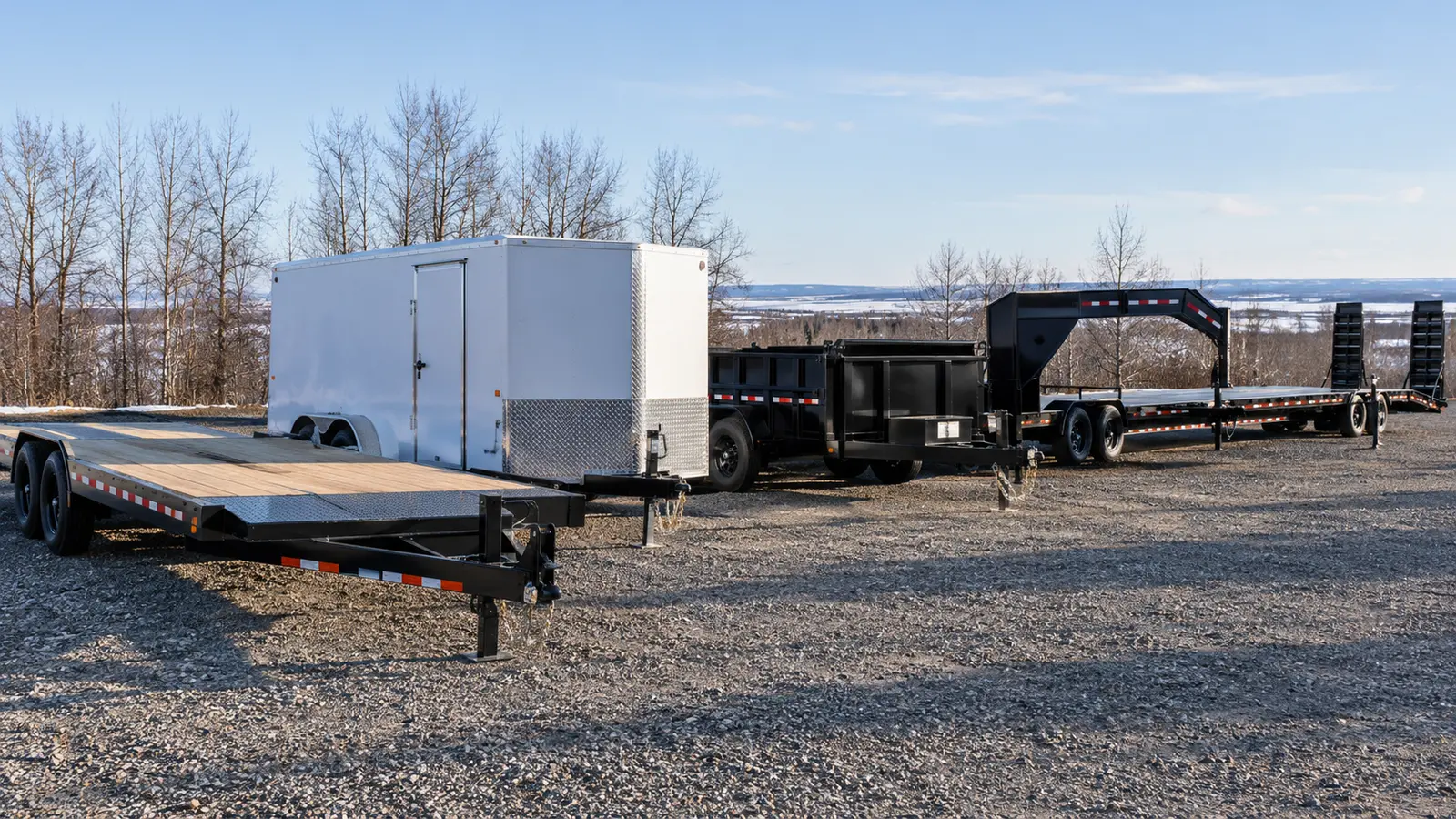
Our partner lenders finance these types of trailers, of any make, from a single utility unit to a fleet order:
- Flatbed
- Semi-trailer and dry van
- Refrigerated (reefer)
- Tank
- Dump and end-dump
- Log and forestry
- Livestock (stock)
- Enclosed cargo
- General utility
Several units can go on the same financing request, and a fleet order follows the same steps as a single trailer.
To finance the tractor that pulls them, see our page on highway tractors and trucks.
Other categories appear on the full list of eligible equipment.
Trailer Financing by Industry
The same flatbed is financed differently for a carrier running year-round routes and for a farm that hauls mostly in the fall. Lenders build a flexible repayment schedule around the cash flow of your operation.
1. Freight and Logistics: Flatbeds, Semi-Trailers and Refrigerated Trailers
Carriers and logistics companies add capacity as their contracts grow, one trailer at a time or several at once. The refrigeration unit, when quoted with the trailer, is financed with it. An owner-operator buying a first trailer is reviewed the same way as a fleet.
2. Forestry: Log Trailers
Log trailer financing can follow the cutting season, with payments scheduled around the hauling months. Log trailers can be financed on the same application as the rest of your forestry equipment.
3. Agriculture: Livestock and Stock Trailers
A farm's revenue arrives in a few large payments, not twelve even ones. Stock trailer financing can be built around that calendar, alongside your farm equipment or on its own.
4. Construction: Dump Trailers
Excavation and construction contractors use dump trailers to move fill, gravel and debris between sites. Dump trailer financing covers the trailer itself, while the truck that pulls it has its own page.
5. Contractors: Utility, Cargo and Enclosed Trailers
Landscapers, renovation contractors and service companies carry tools and materials in enclosed cargo trailers or utility trailers. Cargo trailer financing usually involves smaller amounts and shorter terms, but it goes through the same five-step process as a semi-trailer.
Why Choose Fincap for Trailer Financing?
One financing application with Fincap reaches the lenders whose requirements match your file, each with its own approach to credit profiles, terms and trailer types.
- A request one lender declines can still be accepted by another of the 30-plus lenders in the network.
- Used units qualify alongside new ones, including those bought at auction or from another carrier.
- Sales tax is covered by the lender on the purchase date, then repaid over the term of the lease.
- Our representatives follow your financing request from the first call to funding, and our credit analysts handle the review.
- Fincap holds a 4.9 out of 5 rating based on 122 Google reviews.
Who Qualifies for Trailer Financing?
Financing approval depends on what the business does, how long it has operated and which unit is being financed.
| Criteria | Details |
|---|---|
| Business type | Active Canadian company |
| Time in operation | Startups and established businesses both reviewed |
| Credit history | Different credit situations reviewed, including past difficulties |
| Down payment | Low or none in most cases |
| Trailer | New or used, all makes, bought through any sales channel |
| Coverage | Every province and territory in Canada |
A newly formed company is reviewed on its contracts and the owner's background, and our guide to a new company's first lease explains what lenders ask for.
A separate guide explains what makes a lease financing application stronger and how to present the rest of the file.
Documents Needed for Your Application
Four documents are needed to apply in most cases, and a fifth for larger requests:
- The Fincap credit application
- Business registration or incorporation papers
- The dealer quote, the auction listing or the bill of sale
- The last three months of business bank statements
- Financial statements, for larger requests
An incomplete request can still be submitted: our credit analysts request the missing pieces during the review.
How Trailer Financing Works
Finding the right unit is the longest step, and it happens before you apply.
| Step | What happens | Timeline |
|---|---|---|
| 1. Choose your trailer | From a dealer, an auction or a private seller | Before applying |
| 2. Submit your application | Fill in the online form and attach the quote | About 5 minutes |
| 3. Review your options | Our team lays out the financing options open to you | 24 to 48 hours |
| 4. Select your terms | You pick the schedule that fits your revenue | Same day |
| 5. Get funded | Funds are paid to the seller | On approval |
Apply now once you have the quote in hand.
Typical Trailer Financing Terms
A fleet that works all year and one that works a single season need different repayment schedules, and lenders offer flexible payment options for both.
| Element | Details |
|---|---|
| Term | 24 to 84 months |
| Payment structure | Fixed, seasonal or deferred |
| Equipment condition | New and used both accepted |
| Extras | Attachments and accessories on the same quote |
Fixed monthly payments suit steady work. Seasonal structures, available from several lenders in the network, concentrate payments in the busiest months of the year, and a deferred start gives a new route or a new season time to bring in revenue before payments begin.
New, Used and Auction Trailers
When financing a trailer bought used, lenders look at its condition and resale value, not its age alone. A used trailer follows the same financing process as a new one and can qualify, although an older model may come with a shorter term or a larger down payment.
Buying from another business or at an auction changes the paperwork, not the eligibility. A lender needs proof of what is being bought and at what price. A signed bill of sale, or the listing from the auction house, stands in for the dealer quote. Auction deadlines are short, so send us the listing ahead of the sale to secure financing before bidding closes.
Trailer Financing Across Canada
Where your company is based does not change the financing process. Trailer financing in Ontario, the Prairies, British Columbia or Atlantic Canada goes through the same online form and the same lender network, with no meeting required. Dedicated pages cover the markets we serve most often:
For Trailer Dealers
Dealers can quote financing next to the price, at the point of sale.
Through our vendor program, your quotes can show a financing option, while the credit review stays with our representatives and credit analysts.
Dealers who also sell to individuals can offer financing to their retail customers through a second program.
FAQ About Trailer Financing
Five questions come up most often. Our representatives answer the rest at 819-643-9997 or through the contact form.
1. What credit score do I need for trailer financing?
There is no published minimum. Lenders read the score alongside your time in business, the contracts you hold, the asset and your cash flow. Several lenders in our network work with files that a bank turned down on the score alone.
2. What interest rate can I expect on a trailer?
Rates are set by each lender, based on your credit profile, the age and condition of the equipment, and the structure you choose. We present the financing options side by side so you can compare the monthly cost before you commit.
3. Are trailer lease payments tax deductible?
For most Canadian businesses, lease payments are deducted as an operating expense. Your accountant can confirm how this applies to you, and our article on the tax treatment of lease payments sets out the principle.
4. Does leasing a trailer affect my borrowing capacity?
Small and mid-sized businesses generally do not record a lease as debt on the balance sheet, as they would a term loan. Your line of credit with your bank stays available for other purposes, such as the next truck or seasonal cash needs.
5. Can I finance a truck and its trailer on one application?
Yes. A tractor and a trailer bought from two sellers, on two separate quotes, go through a single application. One review covers both units, and the payments can be set up together.
Calculate Your Monthly Payment
Enter the purchase price and a term in our payment calculator to see an estimated monthly payment.
It gives a first figure before you apply for trailer financing, and the method behind it is set out in how lease payments are calculated.
Ready to Finance Your Trailer?
Send us the quote or bill of sale for the trailer, with a short description of your business. Our credit analysts review the file and come back with the structures available to you, usually within 48 hours. Apply now or call 819-643-9997 to reach one of our representatives.